About Sean Ellis

Former CEO of GrowthHackers.com and Qualaroo. Previous roles include first marketer at Dropbox, Lookout, Xobni, LogMeIn (IPO), and Uproar (IPO). Also interim marketing exec roles at Eventbrite, Socialcast, and Webs.

Ideal Ratio of Product Vs Marketing Spend for a Consumer Startup

Below is an answer I recently put on Quora… Since I haven’t posted on my blog for so long, I figured some people not on Quora might find it useful.

Your marketing spend should be very minimal until you validate that you have created a product that people want or need (an important exception is for network effect products, which I’ll cover later). I would suggest 95/5 ratio between product and marketing. You don’t necessarily need a marketing person on the team to do this early validation.

Once you’ve validated that people want or need the product, you should spend as much as you possibly can on customer acquisition as long as the value of each user exceeds the cost of acquiring them. Often this requires raising additional funding, but if you can present proof of profitable, scalable marketing channels then it should be easy to raise the additional funding. Of course you should complement this paid customer acquisition with free sources if possible (and you can start these early in the validation process). If your product really does a good job solving an important need, you should also have strong organic growth. At this point the spend ratio generally tips toward marketing. I’ve seen it as high as 80% to marketing and 20% to product.

The exception for network effect businesses mentioned earlier is for the following reason… The user experience for a network effect product improves with each additional user. You may need to reach a critical mass of users before you can validate that the product is important for users.

Vision Synching in a Lean Startup

In the age of the lean startup, we often forget about the importance of vision.   A big audacious vision is critical for attracting venture capital and for getting the early team to “take the leap.”  It also stimulates the emotion/passion needed to fuel your team’s persistence to blast through inevitable hurdles.

Vision Needs Traction

Achieving your vision requires first getting traction.   The most realistic way to get traction is to break down your vision to something very relevant now for the sweet spot of your target market.  This MVP (minimum viable product) is a bridge between concrete customer needs today and your big audacious vision.

Customer development teaches us that elements of the MVP are often based on flawed assumptions.  As we validate and refine our assumptions, we need to make sure that the MVP is tracking to these new facts.

Vision Synching/Expanding

It’s also important to revisit your vision when new customer facts emerge.   This often provides inspiration for extending the original vision but you should not be exclusively tied to your original vision.  Always seek more interesting directions to be able to take the business once traction is established.

At FREEjit we’ve mapped out a primary vision but we continue to explore other huge opportunities we could pursue once we have some traction to leverage.  Each new fact adds credence to some potential pivots and reduces the viability of others.  Eventually we’ll need to focus on one vision, but the right vision will crystallize over time.  Even while we explore these opportunities, our current execution is very focused on the MVP needed to get traction.  And the MVP maps well to each of the big opportunities we’re considering.

While vision synching seems like a distraction from gaining traction, I find that it reinvigorates the team and makes the pursuit of traction even more exciting.

Since my team and I are heads down on FREEjit, I don’t have much time to monitor comments.  Instead, I’m hoping to get some discussion around this concept on Quora.  I’ve posted the following question on Quora: “How do lean startups avoid iterating their way into a small niche and missing big opportunities?”  I’d appreciate your thoughts.

The 3 Keys to Success with Freemium

Freemium is a difficult business model to execute but can create a valuable, sustainable company when things go well.  I helped to conceive of and execute the freemium business model at LogMeIn, which is now valued at over $800m.  Since then I’ve helped optimize the model at another 14 startups including DropboxXobni, Eventbrite, Lookout, Webs, WordPress.com, etc.

Through these roles I’ve discovered the following three elements always seem to be present with successful freemium businesses:

1) A free version that provides users with a lot of value and at least one premium version that also offers users a lot of value but is clearly differentiated from your free version

2) Precise metrics-driven execution with a very optimized conversion funnel

3) Deep understanding of customer perceived value and use cases

There are times when freemium doesn’t make sense.  For example, it rarely works with products exclusively targeting enterprises (open source has done well with enterprises, but that’s probably more a function of product flexibility than price). Also, freemium requires that the marginal user cost for the free product is zero or low.  Finally, freemium shrinks the potential revenue of the total addressable market for the category, so the overall market needs to be big enough to still be interesting after a successful freemium company shrinks it.  Of course incumbent players serving the category are unlikely to want to shrink the market, so freemium generally comes from disruptive startups with nothing to lose.

If these startups are able to gain traction and meet the three requirements above, they generally gain strong organic growth and are very defensible businesses.

As startups get better at executing the freemium business model I think we will see a lot more of it in both existing and emerging categories.  Why?  Users have always loved free and the freemium business model makes it viable to offer something of value for free.  Already the model extends well beyond software to dating, identity protection, music, video, phone service…

I’m Founding a Startup

In case you missed my Tweet on Aug 13th “Burn the boats – I’ve reached the point of no return and finally admitting I’m founding a new startup. Details soon.”

I didn’t really intend to become a founder, but was hit with an epiphany of a huge opportunity that I was perfectly suited to execute. I actually tried to push it out of my find for several days (my consulting practice has been fun/lucrative) but I kept having a nagging feeling that it had to be done. I shared the vision with a few venture capitalist friends and they quickly offered to fund it. I then received strong need validation from potential customers, which wasn’t surprising since the original epiphany had been based on engaging many potential customers.  Momentum has been strong ever since (though surely there will be course corrections along the way).

I’ll be on a blogging vacation for the foreseeable future…

The Startup Team

I completely agree with everything Paul Graham says in this short interview…   I’d want to invest in this type of team if they were using a lean startup approach.


Find a Growth Hacker for Your Startup

Once startups are ready to scale, their biggest challenge is often hiring someone capable of leading the growth charge.   A marketer with the right talents and approach can kick some serious ass once product-market fit and an efficient conversion/monetization process have been proven.

But the problem is that most startups try to hire for skills and experience that are irrelevant, while failing to focus on the essential few skills.  Typical job descriptions are often laden with generic but seemingly necessary requirements like an ability to establish a strategic marketing plan to achieve corporate objectives, build and manage the marketing team, manage outside vendors, etc.

Generally speaking, the job requirements/skills mentioned above are not paramount for startups in or before the early growth phase.

After product-market fit and an efficient conversion process, the next critical step is finding scalable, repeatable and sustainable ways to grow the business.  If you can’t do this, nothing else really matters. So rather than hiring a VP Marketing with all of the previously mentioned prerequisites, I recommend hiring or appointing a growth hacker.

What is a Growth Hacker?

A growth hacker is a person whose true north is growth.  Everything they do is scrutinized by its potential impact on scalable growth.  Is positioning important?  Only if a case can be made that it is important for driving sustainable growth (FWIW, a case can generally be made).

The good news is that when you strip away everything that doesn’t have a direct impact on growth, a growth hacker should be easier to hire than a VP Marketing (or maybe an insider already has the needed skills).  I’ve met great growth hackers with engineering backgrounds and others with sales backgrounds.

The common characteristic seems to be an ability to take responsibility for growth and an entrepreneurial drive (it’s risky taking that responsibility).  The right growth hacker will have a burning desire to connect your target market with your must have solution.  They must have the creativity to figure out unique ways of driving growth in addition to testing/evolving the techniques proven by other companies.

An effective growth hacker also needs to be disciplined to follow a growth hacking process of prioritizing ideas (their own and others in the company), testing the ideas, and being analytical enough to know which tested growth drivers to keep and which ones to cut.  The faster this process can be repeated, the more likely they’ll find scalable, repeatable ways to grow the business.

When VP Marketing?

Not all growth hackers can or should evolve into VPs of marketing.  A VP marketing needs to be able to help shape the overall company strategy, build and manage a marketing team and coordinate outside vendors among many other responsibilities.  Some growth hackers will be great at this, while others will be bored out of their minds.  The important thing to note is that without some proven scalable, sustainable ways of growing the business, these things will not matter.

Are You A Growth Hacker?

Some of my favorite conversations are those I have with fellow growth hackers.  Last week in San Francisco, I had breakfast with three fantastic growth hackers and we traded insights that benefited each of us (don’t bother asking me for names to try to recruit them, two are CEOs and the other is VP User Growth at a very hot company).

I’m a big proponent of establishing and building a broader community of growth hackers.  The problem is that not all people are cut out to be growth hackers.   If you think you are a growth hacker, please post a link to your LinkedIn profile below so other growth hackers in your area can connect.

Update Oct 2013 – If you want to get inspired to develop effective growth hacks and engage with other growth hackers, check out our new project at GrowthHackers.com.

Getting to Product-Market Fit

I’m very excited about this guest post and confident that it will be a huge help for anyone struggling to find Product-Market fit. Enjoy! Sean

Guest Post By Patrick Vlaskovits

Sean asked me to write a guest post to help startups achieve Product-Market Fit since he primarily advises startup after they’ve already reached it (during their transition to high growth businesses). Actually getting to Product-Market Fit is an important topic since the vast majority of startups never get there, making it virtually impossible to drive sustainable growth.

I’ve just completed what amounts to a comprehensive study on the topic of getting to Product-Market Fit with Brant Cooper, culminating in our book called The Entrepreneur’s Guide to Customer Development. The most important insights were gained from successful serial entrepreneur, Steve Blank, who encouraged us to write the book as a primer to the first step of Customer Development. Customer Development is the startup framework he codified in his landmark book, The Four Steps to the Epiphany. If you haven’t read the book (you really should), Steve’s many insights are deep, but the core takeaway is that most startups fail not because they don’t manage to develop and deliver a product to the market; they fail because they develop and deliver a product that no customers want or need.  The ramifications of this deceptively simple observation are manifold and underpin much of what you will read below.   Sean has provided a free survey that should be helpful in validating if you have created a product people want or need.

The Entrepreneur’s Guide to Customer Development also folds in the work of Eric Ries.  Eric has built upon Steve’s work and expanded it with his concept of “The Lean Startup.” A Lean Startup is one that combines fast-release, iterative development methodologies (e.g., Agile) with Customer Development concepts.

Wherever you are in the process of taking your product to market, the following Lean Startup and Customer Development concepts can help you achieve Product-Market Fit.  Nothing else really matters to a startup other than getting to Product-Market Fit as fast as possible.   Below is a brief outline, based on The Entrepreneur’s Guide to Customer Development, which will hopefully help you do just that.

Identify and document your assumptions

The sooner you understand and accept that you, as a entrepreneur at somewhere pre-Product Market Fit with your startup, are operating in near-chaos, where all your assumptions/hypotheses about how you gratify your users, who they are, how you will acquire and monetize them – are simply that, untested assumptions, the better off you are.

With your assumptions documented and in-hand you will:

“Get out of the Building” to validate (or invalidate) your assumptions

You must find, meet and speak with prospective customers about your product and ascertain the validity of your assumptions. This is the crux of Customer Development.  Only by speaking to these people will you have any sort of understanding about “their reality” as Dan Martell likes to put it.  What problems do they face?  How do they solve them?  What matters to them?  What is a must-have for them?

As you speak to potential customers, you should:

Identify the risk factors in the opportunity

Are you facing significant technology risks?  Or more of market risk?  How can you test and validate these (starting with the most risky)?  What market testable milestones can you build that would result in sufficient evidence to induce you to pivot or move forward? A proof of concept? A letter of intent?  A prototype?

As your understanding of the market betters, the risks will begin to crystallize, if certain risk factors prove insurmountable, you must:

Pivot but not jump

By changing an element of your customer-problem-solution hypotheses or business model, based on actual learning from a customer. As Eric Ries writes “by testing, each failed hypothesis leads to a new pivot, where we change just one element of the business plan (customer segment, feature set, positioning) – but don’t abandon everything we’ve learned.

The way to test and learn from your market is to build an:

MVP (Minimal Viable Product)

Don’t forget that an MVP is a product with the fewest set of features needed to achieve a specific objective and that you should require a trade of some scarce resource (time, money, attention) for the use of the product, such that the transaction demonstrates the product might be “viable”.

For non-paying milestones, you must define the currency (the scarce resource) and your objective (what you are trying to learn). For example, intermediate MVPs might include: landing page click-through that prove there’s some amount of interest in a product; a time commitment for an in-person meeting to view a demo that shows the customer’s problem being resolved; or a resource commitment for a pilot program to test how the product fits into a particular environment.

Once you have users using your MVP, listen for and tune into the:

Must-have signal

that demonstrates the core product functionality that your customers absolutely must have, while testing your assumptions and learning the characteristics of your market segment that will allow you to reach out and acquire them efficiently.  Sean’s survey, mentioned earlier, can be useful in finding your must have signal.

Once you successfully developed a minimal viable product and have found the must have signal, it is time to:

Double-down and strip away the unnecessary

Now you know what your customers want, you need to focus with laser-like intensity in building a gratification engine that does not disappoint.

If you can do all of the above successfully and throw in a hearty amount of luck for good measure, there is a good chance you can get to Product-Market Fit.  It may take a significant amount of time and persistence, but potential customers always hold the answer to creating a must have product.

My Mixergy Interview

The video from yesterday’s interview with Andrew Warner is now live on Mixergy.com (see embed below).   While Andrew initially characterized me as the “secret weapon behind start-ups that have had incredible growth” I explained that a lot of their growth was based on the pre-existence of great products that met important user needs. I helped these startups build a strong growth foundation around early users’ passion, but the continued momentum is the result of product/engineering teams that keep enhancing the products and great marketers accelerating customer acquisition. Startup success is truly a team accomplishment and if the team starts to focus on who deserves the most credit, success will likely evaporate.

As a successful entrepreneur himself, Andrew did a great job of steering the conversation to the topics most interesting/useful for entrepreneurs. It took me a while to get warmed up (it was a Monday morning after a weekend in Vegas), but there is a lot of new and useful information – particularly in the second half.

Successful startups are only possible with founders who have the guts to go for it so Andrew and I spent a lot of time at the end of the interview trying to analyze the qualities of the best entrepreneurs. Each of the founders I’ve worked with deserve to be on this list, so I regret not mentioning all of them. If the video isn’t loading below, try this link.

Deconstructing Startup Growth

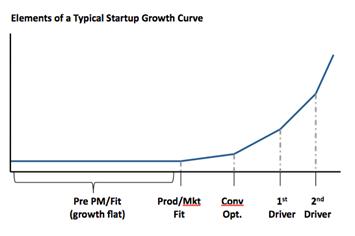
Elements of a startup growth curve

After product/market fit, driving sustainable growth is probably the most important/difficult part of creating value in a startup.

For most of the last 15 years of my startup experience, I’ve been the point person responsible for primarily one thing: driving growth.  Even after two IPOs, I didn’t really have a firm grasp of the essential elements of driving growth.  My view has evolved from externally focused metrics-driven marketing, to a more holistic approach built on a solid foundation of product/market fit.

Growth Foundation

Even the greatest marketers can’t sustain growth on a weak foundation.  Eventually, their growth curves crater.

So what is required for a strong foundation?

Must Have Product

The most important element is having a large percentage of users who consider your product a “must have” (over 40% is a good benchmark).  This gives you two key benefits:

  1. The first is that your churn will be relatively low (if it’s a “must have” why would users leave?), so you won’t be wasting resources filling a leaky bucket.
  2. The second is that “must have” products generally maintain strong word of mouth.

Together, these two elements give you a steady upward trajectory of your growth curve until you reach market saturation (hopefully you are in a big market!).

Must Have is Perishable

An important caveat is that your product will stop being a “must have” if a competitor offering a viable substitute enters your space. If they are really a good alternative to your product, then you’ve been downgraded to a “nice to have” and your foundation starts getting shaky.  Therefore, once you become a “must have” it is critical to get to the growth phase of your business as quickly as possible.

Check out my earlier post to determine if your product is a “must have.”

Conversion Optimization

Your ability to accelerate growth will be greatly enhanced if you optimize conversions.  There are many ways to define a “conversion” but for me, it’s a person who reaches the “must have” experience.  If 1000 new visitors come to your website and only 50 experience the “must have” benefit, it’s very difficult to efficiently grow your business.   However, with focused attention on fine-tuning the first user experience, startups often see a 2x – 10x improvement in conversions.

This immediately enhances your growth curve since word-of-mouth referrals begin “sticking.”  It also greatly enhances your ability to find viable, scalable ways to grow your user base (especially when combined with a good monetization approach).

Driving Growth

Most startups entering the growth stage obsess too much on finding a VP marketing capable of building and managing a large marketing organization.  At this stage your more immediate challenge is finding sustainable, scalable growth drivers to augment the organic growth achieved through solid product/market fit and conversion optimization.  If you are compelled to bring in a VP Marketing at this stage, make sure he/she has a track record of developing scalable growth drivers and is willing to make this their core focus until it is figured out.  Otherwise, I recommend instead bringing in a scrappy growth hacker to generate a strong flow of ideas for experiments that will scale if successful.

The faster you run high quality experiments, the more likely you’ll find scalable, effective growth tactics. Determining the success of a customer acquisition idea is dependent on an effective tracking and reporting system, so don’t start testing until your tracking/reporting system has been implemented. Once scalable growth tactics are developed, then a VP Marketing may be important for building and managing the marketing team that will execute these tactics.

One benefit that is emerging from advising multiple startups is that our rate of collective discoveries is accelerating across the non-competitive network of startups. With sharp, creative growth hackers in each startup we are able to brainstorm and test many more tactics.  The best ones are exchanged across the network for everyone’s benefit.

Growth

As the preceding paragraphs hopefully demonstrate, growth is a function of multiple factors.  Focusing on the right factors at any given time offers the best chance of ultimately becoming a high growth startup.  One exception to this rule are startups like eBay, Facebook, and Twitter, where “must have” status could only be achieved after critical mass.  In these startups, they did not have the luxury to focus on one element at a time – instead they had to work on the full growth ecosystem at one time.  But for most startups, you will approach your full growth potential by obsessively focusing on the most important goal for your particular stage.